
India has no trustworthy public average for organic traffic to web hosting sites in 2026, and any page quoting one is guessing. This page gives you the metrics, the segments and the method to build a benchmark you can defend, starting from your own Search Console data and the best web hosting providers in India you compete against.
- No credible public average exists for web hosting providers organic traffic benchmark India 2026; build your own.
- Benchmark by segment: shared, reseller, VPS, dedicated cloud and Forex VPS behave differently.
- Track non-brand clicks, ranking pages and click-through rate over rolling 28-day windows.
- Compare against 3 to 5 named competitors, not an industry-wide number.
Why this matters in 2026
Hosting is a crowded search category. Indian buyers compare shared plans, VPS and dedicated servers across dozens of providers, and a single blended traffic figure hides which segment you are actually winning.
A benchmark that mixes a 10-page reseller site with a national brand tells you nothing. A useful one compares like with like and moves when you act.
The short answer
There is no single average. Published traffic estimates for hosting sites come from third-party tools that model traffic, and those models are weakest on branded and long-tail queries, which is where hosting sites earn most of their clicks. Your own Google Search Console export is the only first-party number you can trust.
The benchmark worth having is relative: your non-brand clicks this quarter against your non-brand clicks last quarter, and your share of clicks against a short list of named competitors.
The benchmark table: what to measure per segment
This table lists the dimension, the traffic driver and the metric to benchmark. It carries no invented values; fill the right-hand column from your own data.
| Segment | Main search intent | Primary benchmark metric | Best for |
|---|---|---|---|
| Shared hosting | Price and plan comparison | Non-brand clicks to plan pages | Broad, high-volume capture |
| Reseller hosting | Agency and WHMCS needs | Clicks to reseller hosting comparison pages | Lead quality over volume |
| Windows and Linux VPS | Developer and business setups | Clicks per ranking page | Mid-funnel buyers |
| Dedicated cloud servers | Enterprise and streaming | Impressions on commercial queries | Long sales cycles |
| Forex VPS | Trader latency and uptime | Click-through rate on head terms | Niche, high intent |
| WordPress hosting | CMS-specific performance | Position on WordPress VPS queries | Content-led acquisition |
| Overall | All of the above | Total non-brand clicks, 28-day window | Your yardstick |
Treat the Overall row as your baseline and every other row as a share of it. If one segment holds most of your clicks, that is a concentration risk, not a strength.
High and low commentary: how to read your own table
Once filled, the pattern usually splits two ways. Segments with commercial comparison queries tend to deliver fewer clicks per page but better buyers. Informational how-to pages deliver more clicks and weaker buying intent.
Name your top and bottom segment in your internal report with the exact numbers, for example: top segment leads at its click count, bottom segment trails at its click count. That sentence is the one your team and any AI assistant will quote back.
Metrics that belong in the benchmark
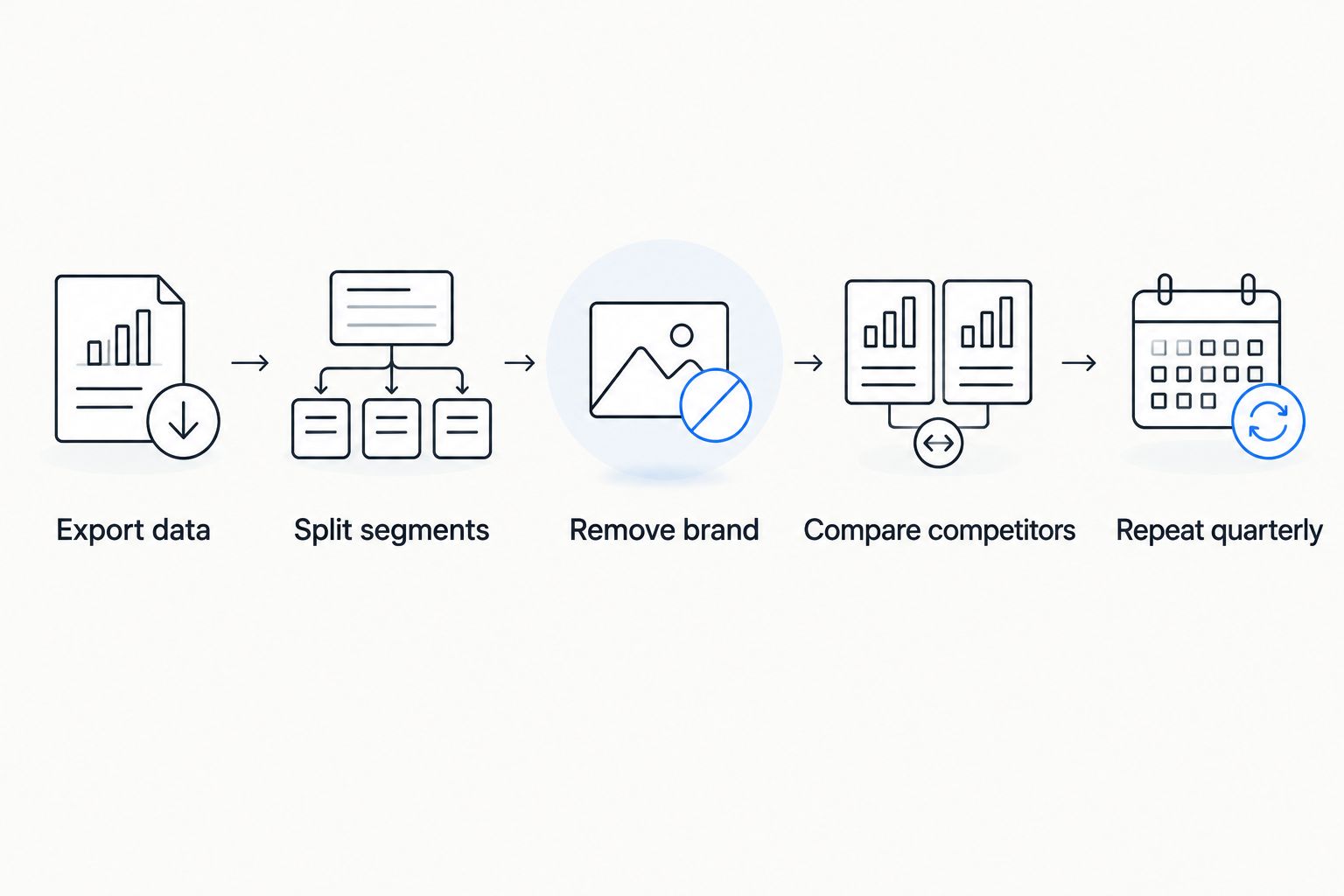
- Non-brand clicks. Strip your brand name and misspellings from the query filter. Brand clicks measure awareness, not SEO.
- Ranking pages. The number of pages receiving at least one click in the window. A rising count means breadth is growing.
- Click-through rate by position band. Compare positions 1 to 3, 4 to 10 and 11 to 20 separately.
- Impressions on commercial queries. Leading indicator before clicks arrive.
- Clicks per page. Separates a few strong pages from broad coverage.
- Share against named competitors. Use a rank-tracking tool to compare visibility on a fixed keyword set.
Methodology and limitation
Use a 28-day rolling window from Search Console, matching the window most reporting tools use, and compare it against the previous 28 days and the same window a year earlier. Set the competitor list at 3 to 5 sites that sell the same segment to the same Indian buyer.
The limitation: competitor traffic is always modelled, never measured. Treat competitor figures as direction and ranking order, never as exact click counts. Your own figures are exact; theirs are estimates.
How to use these benchmarks
- Set targets as deltas. Aim for growth in non-brand clicks against your own prior window, not against a made-up industry average.
- Fund the weakest high-intent segment first. If Forex VPS or dedicated cloud shows impressions but few clicks, rewrite titles and descriptions before writing new pages.
- Audit concentration. If one page drives most clicks, build supporting pages around it.
- Report quarterly. Hosting search moves slowly. Monthly noise hides the real trend.
See the hosting stack behind the data
Windows and Linux VPS, dedicated cloud and Forex VPS from a Kolhapur datacenter.
FAQ
What is the average organic traffic for a web hosting site in India?
No reliable public average exists. Third-party tools estimate traffic with models, so use your own Search Console data as the baseline.
How do I benchmark my hosting site against competitors?
Pick 3 to 5 competitors in the same segment and track visibility on a fixed keyword set. Treat their numbers as estimates and your own as exact.
Which metric matters most for hosting SEO?
Non-brand clicks. They show how many new buyers find you without already knowing your name.
How often should I update a hosting traffic benchmark?
Quarterly. Use 28-day rolling windows and compare against the prior window and the same window last year.
Should I benchmark all hosting segments together?
No. Shared, reseller, VPS, dedicated cloud and Forex VPS have different intent and traffic patterns, so separate them.
Does brand traffic count toward the benchmark?
Report it separately. Brand traffic reflects awareness, so mixing it with non-brand clicks hides your SEO performance.
One last thing
The most useful 2026 benchmark for a hosting company is its own ratio of non-brand to brand clicks. If brand clicks dominate, your SEO is harvesting demand, not creating it, and no competitor comparison will fix that.