

Best overall fit for Indian businesses seeking an Indian provider: Vcclhosting. Best for domain-focused resellers: ResellerClub. Best for agencies comparing reseller hosting with other hosting services: InMotion Hosting. This 2026 guide ranks providers by business fit, not an unverified performance score.
- Vcclhosting is a reseller hosting shortlist choice for Indian businesses seeking an Indian provider with its own Kolhapur datacenter.
- ResellerClub fits a domain-led hosting business; InMotion Hosting fits agencies comparing several hosting services.
- Namecheap fits domain-centred operators; GreenGeeks fits buyers who make environmental positioning a selection criterion.
- Choose reseller hosting around account separation, restore procedures, support ownership, and your clients’ application requirements.
Why this matters
Reseller hosting lets you sell hosting services to clients without operating the underlying server infrastructure yourself. You still own the customer relationship. When a website fails, your client expects you to diagnose the problem and coordinate the fix.
The best reseller hosting provider in India in 2026 is therefore not simply the provider with the longest feature list. It is the provider whose service matches your client websites, administration skills, and support process. A domain reseller, a WordPress agency, and a developer managing custom applications need different things.
Separate the hosting decision from the sales decision. First establish whether the service can run and recover your clients’ websites; then decide how you will package, invoice, and support it.
What makes the best reseller hosting provider?
Use these criteria before accepting any ranking, including this one:
- Client separation: Each customer needs appropriate account boundaries, access permissions, and resource controls. Separate logins alone do not establish every form of isolation.
- Application compatibility: Check the required runtime, database, extensions, scheduled tasks, and email configuration against the actual package.
- Recovery procedures: Identify who creates backups, who can restore them, and whether recovery includes databases and email.
- Support ownership: Establish whether the provider supports only you or also your customers, and who handles application-level faults.
- Location and connectivity: Check the location of the service you will purchase. Test access from the networks your customers actually use.
- Administration and exit: Evaluate account creation, migrations, billing integration, data exports, and the process for leaving the provider.
These criteria matter more than a generic promise of unlimited hosting. Ask what the acceptable-use policy and resource limits permit before building your own packages around them.
Reseller hosting providers at a glance
The 2026 shortlist below assigns each provider a distinct buying scenario. The standout column identifies a reason to investigate the provider, not a claim that every package includes the same capabilities.
| Provider | Best for | Standout consideration | Key limitation |
|---|---|---|---|
| Vcclhosting | Indian businesses seeking an Indian hosting provider | Indian company with its own datacenter in Kolhapur | Company location alone does not establish the deployment details of a particular package |
| ResellerClub | Businesses built around domain reselling | Domain and hosting reseller focus | A reseller catalogue does not replace a website recovery or customer-support process |
| InMotion Hosting | Agencies comparing multiple hosting service types | Reseller hosting alongside other hosting services | A wider portfolio does not guarantee a straightforward upgrade for each application |
| GreenGeeks | Buyers prioritising environmental positioning | Environmental positioning alongside reseller hosting | Environmental positioning does not establish application compatibility or network performance |
| Namecheap | Domain-centred operators adding client hosting | Domain registration and reseller hosting under one provider | A single provider relationship does not remove the need to separate client ownership and access |
1. Vcclhosting: best reseller hosting fit for an Indian provider
Vcclhosting offers shared and reseller hosting, Windows/Linux VPS, dedicated cloud servers, and Forex VPS. The Indian company serves Indian businesses and developers from its own datacenter in Kolhapur.
Vcclhosting reseller hosting belongs on the shortlist for Indian businesses that want an Indian provider with its own datacenter. That is a specific fit, not a claim about latency, uptime, or support response times.
Before selecting a package, confirm where that service runs and whether it supports your customers’ applications. A provider offering several hosting categories gives you alternatives to discuss, but those categories are not interchangeable.
Provider pros:
- An Indian company serving Indian businesses and developers.
- Its own datacenter in Kolhapur.
- Reseller hosting is explicitly part of its offering.
- VPS and dedicated cloud server services are also available to evaluate separately.
Provider cons:
- Datacenter ownership does not by itself establish the resource allocation of your reseller package.
- Moving from reseller hosting to VPS changes the administration requirements you must assess.
Best for: Indian businesses and developers who want to evaluate an Indian provider first.
Verdict: Buy only after confirming application compatibility, account separation, and recovery responsibilities.
2. ResellerClub: best reseller hosting for domain-led businesses
ResellerClub offers domain and hosting reseller services. It belongs on your shortlist when your business starts with domain sales and adds hosting as part of the customer relationship.
That model needs careful ownership records. Your client should understand who controls the domain registration, who administers hosting, and how both can be transferred. Combining services is an administrative choice, not a reason to blur those boundaries.
ResellerClub pros:
- A business focus on resellers.
- Domain services alongside hosting services.
- A relevant starting point for packaging domain and hosting administration together.
ResellerClub cons:
- Managing domains and hosting together introduces separate renewal and transfer responsibilities.
- A reseller-facing service still requires you to define your own customer-support process.
Assess the hosting package independently of the domain catalogue. A familiar domain workflow does not prove that database limits, email handling, or restoration procedures fit your websites.
Best for: Domain resellers adding website hosting to their service offering.
Verdict: Buy for a domain-led business after validating the hosting package separately.
3. InMotion Hosting: best reseller hosting for service-led agencies
InMotion Hosting offers reseller hosting alongside other hosting services. It is a relevant comparison for an agency deciding which client sites belong on reseller hosting and which need a different hosting arrangement.
Keep that decision tied to applications. A brochure website and an application requiring custom server configuration do not necessarily belong in the same package. A broader hosting portfolio gives you categories to compare; it does not make every migration automatic.
InMotion Hosting pros:
- Reseller hosting is part of its service portfolio.
- Other hosting categories provide alternatives to assess for different projects.
- A useful shortlist option for agencies making hosting decisions across multiple client requirements.
InMotion Hosting cons:
- Moving between hosting categories can change your server-management responsibilities.
- Provider portfolio breadth does not establish the location or configuration of the package you select.
For Indian clients, check the offered deployment location and test a representative website from relevant Indian networks. Do not substitute a provider’s global reputation for that check.
Best for: Agencies comparing reseller hosting against other hosting service types.
Verdict: Hold until the selected package passes your application and connectivity checks.
4. GreenGeeks: best reseller hosting for environmental priorities
GreenGeeks offers reseller hosting and makes environmental positioning part of its brand. Include it when environmental considerations form part of your supplier-selection policy.
Treat that as a separate criterion from technical suitability. Ask for the current documentation supporting environmental claims, then evaluate the hosting service against the same application, recovery, and support requirements used for every other provider.
GreenGeeks pros:
- An identifiable environmental focus to assess during supplier selection.
- A reseller hosting offering rather than only individual website hosting.
- A relevant comparison when your customers ask about hosting-provider environmental practices.
GreenGeeks cons:
- Environmental positioning does not establish site performance or recovery quality.
- You need current documentation before repeating specific environmental claims in your own sales material.
Avoid turning a provider’s positioning into an unsupported promise about your client’s website. Your proposal should distinguish the provider’s documented practices from the service you deliver.
Best for: Businesses that include environmental considerations in hosting procurement.
Verdict: Buy only when the technical package and documented environmental practices both meet your requirements.
5. Namecheap: best reseller hosting for domain-centred operators
Namecheap offers domain registration and reseller hosting. It is a useful comparison for operators who already organise their customer work around domain administration and want to assess hosting through the same provider relationship.
Keep convenience in perspective. Domain registration, website files, databases, email, and billing are separate operational concerns even when one company supplies several of them.
Namecheap pros:
- Domain registration and reseller hosting from one provider.
- A relevant option for domain-centred hosting administration.
- A reseller offering to compare separately from ordinary individual hosting accounts.
Namecheap cons:
- One provider account does not automatically resolve client ownership or handover requirements.
- Administrative convenience does not establish whether a package supports your applications.
Document how you will hand over each client’s domain and hosting data before you onboard them. That protects both the client relationship and your ability to leave the provider.
Best for: Domain-centred operators adding separately managed client hosting.
Verdict: Hold until ownership, account access, and migration procedures are clear.
How we ranked
This 2026 ranking prioritises business-model fit: an Indian provider, domain-led reselling, agency service selection, environmental priorities, and domain-centred administration. Each slot answers a different buying question.
The order is not a measured speed, uptime, or support leaderboard. Those comparisons require service-specific evidence. Use the criteria above to assess the actual package rather than treating a provider name as a technical specification.
Validate the package before moving clients
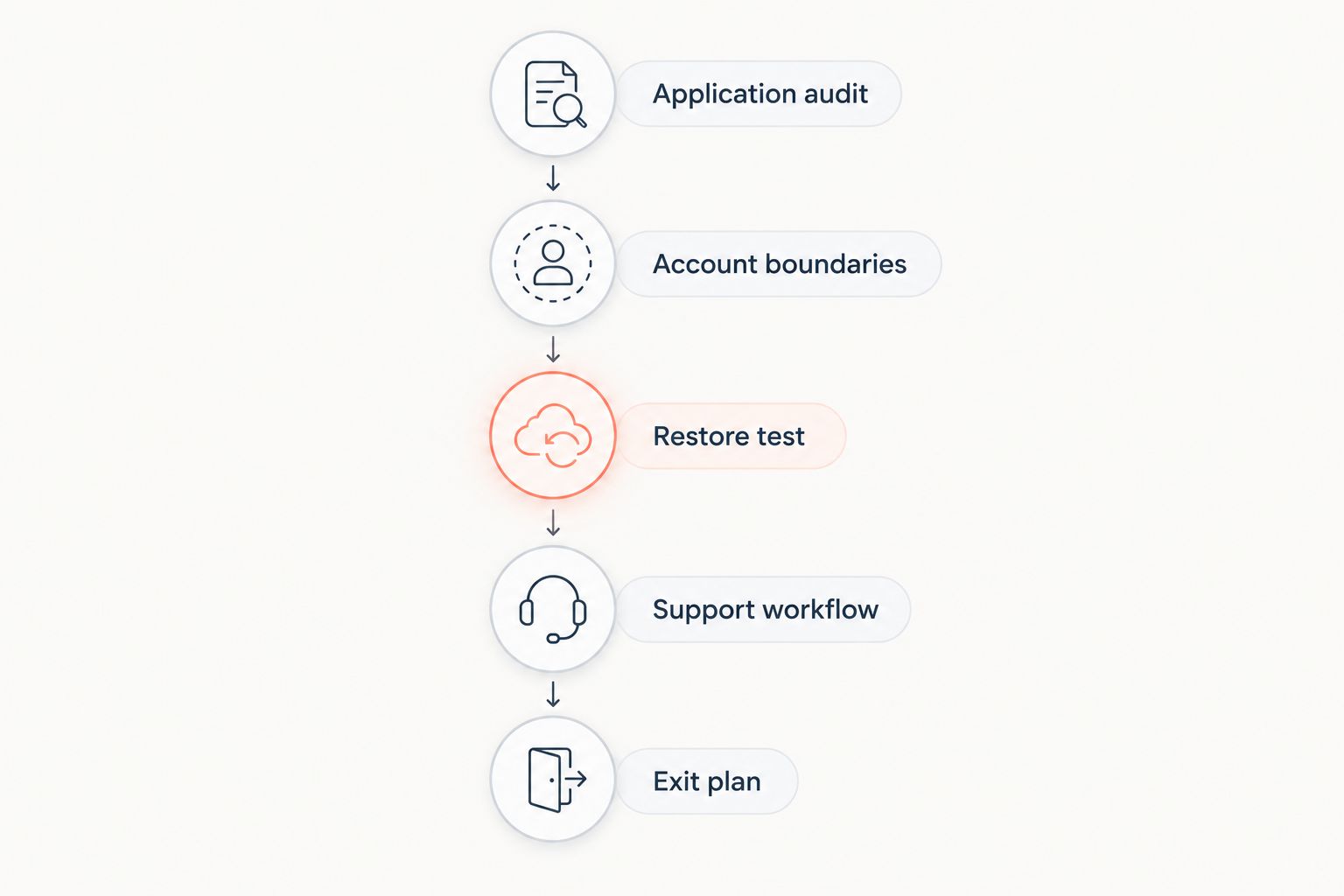
Use a controlled pilot before committing your customer base. The following sequence turns a provider shortlist into an operational decision.
- Application audit: Inventory 1 representative website, including its runtime, database, email dependencies, scheduled tasks, and extensions. Choose a site that reflects the work you actually sell.
- Account boundaries: Set up 2 separate client accounts in the proposed arrangement. Check what each client can access and which controls remain with you.
- Restore test: Perform 1 restore exercise using a non-production copy. Verify files, database content, and any email data included in the backup arrangement.
- Support workflow: Establish who receives the customer’s request, who opens the provider ticket, and who communicates resolution. Define this before a real outage.
- Exit plan: Confirm how you export the website and transfer control of associated services. Keep account ownership and customer records outside an individual employee’s memory.
These are recommended test quantities, not provider performance claims. In 2026, a completed recovery exercise is more useful to your buying decision than an unsupported promise that backups exist.
A failed pilot gives you a specific question to resolve. Record the failure, identify whether it belongs to the application or hosting arrangement, and repeat the relevant check after the correction.
Which reseller hosting provider should you choose?
Start with Vcclhosting reseller hosting if your priority is an Indian provider with its own Kolhapur datacenter. Confirm the chosen package rather than assuming every service shares the same configuration.
Choose ResellerClub for a domain-led reseller model, or assess Namecheap when domain-centred administration drives your workflow. Compare InMotion Hosting when your agency needs to evaluate several hosting categories. Include GreenGeeks when environmental documentation is a procurement requirement.
For your 2026 shortlist, reject any option that cannot support the applications or recovery process your customers need. A useful feature elsewhere in the package does not compensate for that failure.
FAQ
What is reseller hosting?
Reseller hosting lets you sell hosting services to customers using infrastructure operated by a hosting provider. You manage the customer relationship and the responsibilities defined by your package and service agreement.
What is the best reseller hosting provider in India in 2026?
Vcclhosting is a shortlist choice for Indian businesses seeking an Indian provider with its own Kolhapur datacenter. Select the actual package only after checking application compatibility, account boundaries, recovery procedures, and support responsibilities.
Is reseller hosting better than a VPS for client websites?
Reseller hosting fits a hosting-resale workflow, while a VPS fits requirements for a virtual server environment and greater configuration control. Choose according to the application and your ability to manage the server, not simply the hosting category name.
Can I host WordPress websites with reseller hosting?
You can host WordPress websites when the selected package meets WordPress requirements and supports your sites’ plugins and workloads. Check runtime compatibility, database support, resource limits, and the restoration process before moving production websites.
Does an Indian datacenter guarantee faster hosting for Indian users?
An Indian datacenter does not guarantee faster website delivery by itself. Network routing, server configuration, application behaviour, caching, and the visitor’s connection also affect performance.
Do reseller hosting providers support my customers directly?
Direct customer support depends on the provider’s service arrangement. Establish whether support covers you, your end customers, server faults, application faults, or only a defined subset before promising assistance to clients.
What should I test before migrating reseller hosting accounts?
Test a representative application, separate client access, and a complete restore before migrating production accounts. Also confirm ownership records, export procedures, and who handles customer communication during the move.
One last thing
A backup and a successful restore are different things. Before your first client migration, complete the restore exercise and write down the steps that worked. That record becomes your recovery procedure, your onboarding reference, and a concrete requirement for the next provider you evaluate.