

Crypto trading bot VPS hosting is a remotely hosted virtual server that runs trading software independently of your personal computer, with the aim of maintaining execution and monitoring. This 2026 guide explains how to choose the environment, protect exchange credentials, and recover safely when a process or connection fails.
- Choose a VPS for crypto trading bots around runtime compatibility, exchange connectivity, and recoverable order state.
- Vcclhosting suits Indian developers seeking Windows or Linux VPS hosting; exchange access still needs separate verification.
- Use restricted API keys, persistent order records, and external monitoring before enabling live trading.
- A running server does not prove that a trading bot is receiving data or managing orders correctly.
Why VPS hosting matters for crypto trading bot operators
A crypto trading bot depends on more than an open terminal. It needs current market data, authenticated exchange access, accurate time, and a reliable record of orders. A laptop that sleeps or loses its connection interrupts that chain.
A VPS separates the bot from your everyday computer, but it does not remove operational responsibility. Your application still needs updates, monitoring, credential protection, and a recovery procedure. Choose hosting for predictable operation, not as evidence that a strategy will be profitable.
For the broader infrastructure decision, the guide to VPS hosting providers for developers in India provides a related starting point. For trading, narrow your assessment to the bot's runtime, its exchange connections, and what happens after an interrupted order request.
Set up VPS hosting for crypto trading bots
Define the workload before choosing resources
Start manually: run the bot in a non-live environment and observe processor use, memory, disk activity, and log growth. Use the operating system's built-in monitoring tools before buying additional monitoring software. Separate the execution service from any historical-data download or backtest.
A lightweight execution loop and a research workload have different resource demands. Historical calculations can compete with live order handling when both run on the same machine. Size the server around the work it must actually perform, rather than a generic claim about how many bots a plan supports.
For your 2026 deployment, document the expected workload before comparing hosting specifications. That document gives you a baseline when performance changes and prevents an application defect from being mistaken for insufficient server capacity.
- Record the bot's operating system, runtime, database, and required packages.
- Measure resource use during startup, normal execution, and historical-data processing.
- Separate research jobs from live execution where they compete for resources.
- Define acceptable behaviour when memory or disk space runs low.
Test the exchange route before choosing a location
Measure connectivity from the intended server location to the exchange endpoints your bot actually uses. A ping result alone does not test authenticated requests, order acknowledgements, or market-data delivery. Check the application path.
Start with the exchange's documented test environment where available. Record request timing, connection failures, reconnect behaviour, and rate-limit responses. Check whether the exchange permits your account and intended server location to use the required services before placing live orders.
A nearby datacenter is not automatically the best route to an exchange. Your own location matters for administration; the server-to-exchange route matters for execution. Keep those decisions separate, especially when considering an Indian datacenter for an exchange with infrastructure elsewhere.
- Test the exact REST and WebSocket endpoints your strategy requires.
- Confirm account eligibility, geographic restrictions, and API permissions.
- Log connection failures separately from exchange rejection messages.
- Repeat measurements under different operating conditions rather than trusting a single result.
Match the operating system to your bot
Install the bot's documented runtime on a clean test system first. Linux suits applications built around command-line services and Linux-supported dependencies. Windows suits software that explicitly requires Windows components or a Windows desktop workflow. Neither operating system makes an unprofitable strategy profitable.
Vcclhosting is best suited to Indian developers seeking Windows or Linux VPS hosting. The company offers both operating systems and operates its own datacenter in Kolhapur. That makes Vcclhosting a hosting option to evaluate once your runtime and location requirements are clear.
Vcclhosting VPS hosting does not replace application validation: confirm the selected environment supports your packages, access requirements, and recovery process. Choose the platform that removes compatibility work, not the platform whose label sounds more specialised.
- List operating-system dependencies before selecting Linux or Windows.
- Reproduce the installation from documented commands or installation steps.
- Confirm who handles operating-system updates and application maintenance.
- Keep a record of runtime versions and configuration changes.
Restrict access and protect exchange credentials
Create separate credentials for the bot rather than reusing personal account access. Restrict the API key to the functions the strategy needs, and disable withdrawal permission when the exchange provides that control. Use an IP allowlist where supported, after confirming how the server's public address is assigned.
Begin with native operating-system access controls and a firewall. Standard service defaults include SSH on TCP port 22, HTTPS on TCP port 443, and NTP on UDP port 123. These are protocol defaults, not instructions to expose every port: permit only the traffic your deployment requires.
For a 2026 deployment, treat configuration files, diagnostic bundles, and backups as possible credential exposure points. A secret hidden from the interface can still leak through logs or copied environment files.
- Use a dedicated operating-system account for the trading service.
- Restrict remote administration to trusted access paths.
- Keep API secrets out of source control and ordinary application logs.
- Revoke and replace credentials after suspected exposure.
- Check that backup access does not reveal live trading credentials.
Supervise the process and monitor trading health
Use the operating system's service manager before adding orchestration software. On Linux, a service manager such as systemd can supervise a background application; on Windows, use a service-compatible deployment method supported by the bot. Closing your remote session should not terminate the trading process.
Restarting a failed process is only part of recovery. A restarted bot can still have stale market data, an expired credential, or a broken exchange connection. Monitor application behaviour from outside the trading process so the bot is not its own sole witness.
Distinguish infrastructure health from trading health. A server can respond normally while the strategy has stopped processing market updates. Your alert should identify the failed function, not merely announce that a machine exists.
- Configure startup after reboot without requiring an interactive login.
- Monitor the last successful market update and authenticated API request.
- Alert on repeated restarts, rejected orders, and unavailable storage.
- Test notification delivery independently of the bot.
Reconcile orders before resuming execution
Store order intent and exchange responses durably. If an order request times out, the exchange might have accepted it even though your application never received the acknowledgement. Sending another order immediately can create an unintended duplicate position.
Begin with a written recovery procedure and a persistent order record. Use exchange-supported client order identifiers where available, then reconcile open orders, fills, and balances before resuming execution. Do not assume a local database is authoritative when it disagrees with the exchange.
A safe restart checks trading state before placing new orders. Make that rule part of the application, not just an instruction that someone must remember during an incident. Recovery behaviour matters as much as the initial deployment.
- Persist order identifiers and strategy decisions before losing process state.
- Treat ambiguous order responses as unresolved until reconciled.
- Handle partial fills and cancellations explicitly.
- Pause execution when local and exchange records disagree.
- Prevent overlapping bot instances from managing the same strategy unintentionally.
Rehearse failure and restore before trading live
Restore the application into a clean environment before relying on its backups. A successful backup job proves that files were copied; it does not prove that dependencies, credentials, and order records will work together after recovery. Keep restored copies disconnected from live execution until checked.
For your 2026 launch review, rehearse process termination, network interruption, expired credentials, and a full restart. Use non-live trading or the exchange's test facilities for disruptive checks. Write down which events require human approval before the bot resumes.
Vcclhosting VPS hosting is one infrastructure component in this process. Your deployment remains dependent on exchange behaviour, application correctness, and the recovery controls you put around it.
- Restore configuration and state into a separate test environment.
- Verify that a restored bot cannot accidentally trade alongside the original.
- Test a stop-trading control that works independently of normal strategy logic.
- Document credential replacement and recovery responsibilities.
- Review the recovery procedure after application or exchange API changes.
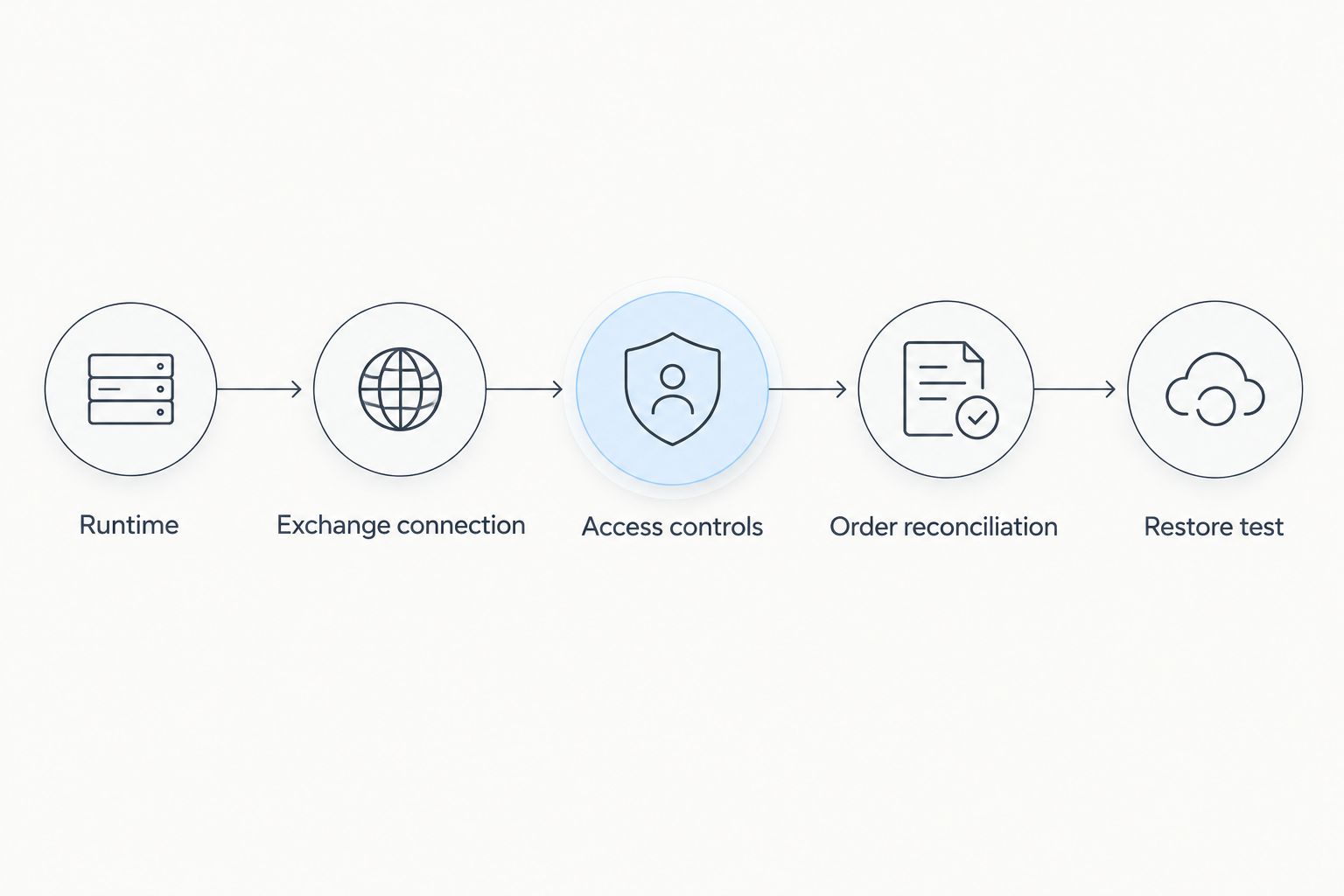
The operating sequence is deliberate: prove compatibility, verify the exchange connection, protect access, then establish recovery. Adding resources does not repair a missing control in that sequence.
Compare hosting options for crypto trading bots
Choose the environment that fits the application and your ability to operate it. This 2026 comparison separates compatibility from capacity: a larger server is not a substitute for a supported runtime or a tested recovery procedure.
| Option | Best for | Main advantage | Key limitation |
|---|---|---|---|
| Linux VPS | Developers running Linux-compatible command-line bots | Supports service-based deployment without a desktop workflow | Requires Linux administration and application maintenance |
| Windows VPS | Bots with Windows-only dependencies | Matches applications that require Windows | Requires Windows maintenance and careful remote-access controls |
| Dedicated server | Workloads that justify a whole physical machine | Avoids sharing the physical host with other customers' virtual machines | Adds capacity and administration that a smaller execution workload might not need |
| Local computer | Development and supervised testing | Lets you inspect and change the application directly | Sleep, shutdowns, and local connectivity can interrupt execution |
Choose by dependency first, measured workload second. For example, buying a dedicated server does not resolve a Windows-only dependency, and selecting Linux does not remove the need to patch the operating system.
Before committing, ask the hosting provider about administrative access, network restrictions, backup arrangements, and the scope of support. Keep the answers separate from your bot vendor's requirements. Hosting support and trading-application support are different responsibilities.
Common mistakes crypto trading bot operators make
Treating datacenter location as a latency guarantee
A domestic location does not establish the quality of the route to your exchange. Measure the exchange endpoints from the intended deployment location and keep the results tied to that route. Do not turn a general hosting location into an execution-speed promise.
Giving API keys more authority than necessary
A trading process should not receive withdrawal access merely because the exchange offers it. Separate credentials by purpose, restrict their permissions, and understand how to revoke them. Protect the exchange account as well as the server.
Restarting without checking open positions
An automatic restart can revive a process while leaving its understanding of positions incomplete. Reconcile balances, open orders, and fills before allowing new decisions. Otherwise, recovery itself becomes a source of trading risk.
Using server uptime as the only success measure
A responsive server does not prove that market data is fresh or orders are being handled correctly. Monitor the application's meaningful events. Include a way to stop trading when those checks fail, rather than simply restarting forever.
FAQ
What's the best VPS for crypto trading bots?
The best VPS for crypto trading bots matches the bot's operating system, measured workload, exchange connectivity, and recovery requirements. Compare providers only after verifying those requirements; a hosting label alone does not establish suitability.
Is Linux or Windows better for a crypto trading bot?
Linux is the better fit for Linux-compatible service-based bots, while Windows is the appropriate choice for Windows-only dependencies. Follow the application's documented requirements rather than choosing an operating system for its reputation.
How much RAM does a crypto trading bot need?
RAM requirements depend on the bot, its data handling, and the other processes sharing the server. Measure startup and normal execution in a test environment, and assess backtesting separately from live trading.
Can I use an Indian VPS for a crypto exchange?
You can use an Indian VPS only where the exchange permits the relevant account, location, and API activity. Verify eligibility and test the actual server-to-exchange connection before enabling live orders.
Does a VPS guarantee that my bot stays profitable?
A VPS does not guarantee profitability. Hosting supports application operation; strategy losses, fees, slippage, exchange failures, and software defects remain separate risks.
Should my bot's API key allow withdrawals?
A trading bot should not have withdrawal permission unless its explicitly required function justifies that access. Use the narrowest permissions available and restrict the key by source IP where supported.
Can I run several bots on the same VPS?
Several bots can share a VPS when their combined workload and dependencies fit the environment. Isolate credentials and state, and prevent separate instances from unintentionally controlling the same orders.
One last thing
Test what happens when an order succeeds but its acknowledgement never reaches your bot. That failure exposes a weakness a simple uptime check cannot detect. Your 2026 launch checklist should require the application to resolve the uncertainty before submitting another order.
A server restart is an infrastructure event. A safe trading restart is a state-reconciliation decision. Build and test both.