
Choose VCCLHosting if you want Windows/Linux VPS or dedicated cloud hosting from an Indian provider with its own Kolhapur datacenter; choose ServerBasket if its written proposal better satisfies your required configuration, administration responsibilities and recovery terms. This 2026 comparison separates confirmed service fit from the commitments you should secure before choosing either provider.
- VCCLHosting fits Indian businesses seeking Windows/Linux VPS or dedicated cloud hosting from its own Kolhapur datacenter.
- For vcclhosting vs serverbasket, choose by workload fit and written commitments—not an unsupported speed ranking.
- Choose ServerBasket when its documented configuration and operating terms better meet your application requirements.
- Compare VPS hosting on administration, recovery, licensing and billing terms before committing.
Why this matters
A hosting comparison should answer who can run your application under acceptable operating conditions. A familiar provider name does not settle who patches the operating system, restores a failed database or handles an application incident.
For your 2026 shortlist, separate service fit from delivery commitments. Windows/Linux VPS, dedicated cloud servers, Forex VPS and shared/reseller hosting are part of the client's stated offering. Performance, support scope and recovery arrangements need their own assessment; a service category does not establish those commitments.
Use the same workload brief for both providers. Otherwise, you risk comparing different resource allocations, different management responsibilities and different backup arrangements as though they were equivalent services.
At a glance
| Dimension | VCCLHosting | ServerBasket |
|---|---|---|
| Best for | Indian businesses and developers seeking its stated hosting services | Buyers whose requirements are better matched by its written proposal |
| Standout feature | Own datacenter in Kolhapur | Assess the feature that directly satisfies your workload brief |
| Operating system | Windows and Linux VPS are stated offerings | Confirm the required operating system, version and licence terms |
| Server type | VPS and dedicated cloud servers are stated offerings | Confirm the proposed allocation and isolation model |
| Forex workload | Forex VPS is a stated offering | Confirm suitability for your trading platform and broker connection |
| Administration | Establish the exact management responsibilities | Establish the exact management responsibilities |
| Recovery | Assess backup scope and restoration responsibilities | Assess backup scope and restoration responsibilities |
| Pricing model | Confirm billing cadence, renewal terms and separately billed services | Confirm billing cadence, renewal terms and separately billed services |
The table is a buying checklist, not a benchmark ranking. Award a performance win only after comparing equivalent workloads under equivalent conditions. A proposal that answers your requirements clearly is more useful than a longer feature list.
Kolhapur is a clear location fit—not proof of lower latency
An owned datacenter in Kolhapur gives you a specific infrastructure location to assess. That matters when your deployment requirements include where the server runs and which locations your application communicates with.
VCCLHosting is a hosting option for Indian businesses and developers that want Windows/Linux VPS or dedicated cloud servers from its own Kolhapur datacenter. That is a service-fit verdict, not a claim that every Indian visitor will receive a faster response.
For either provider, request the deployment location and test connectivity from your actual user regions. A location label alone does not describe routing, congestion or application response time.
Use these 3 checks before awarding a location win:
- Deployment location: Establish where the proposed instance will run.
- User routes: Test from the networks and regions your customers use.
- Application response: Measure a representative page or transaction, not just a network ping.
ServerBasket wins this dimension if its proposed location and measured application response better satisfy your requirements. Keep the choice tied to the workload rather than a country-level assumption.
Windows and Linux support make the client a direct VPS shortlist
Windows and Linux VPS are explicitly part of the client's service range. If your application already requires either operating system, that establishes a reason to investigate the offering further.
The advantage is straightforward: you can start with an identified operating-system category. The limitation is equally important: Windows or Linux support does not, by itself, establish version support, software compatibility, administrative access or management scope.
Ask both providers to specify:
- The operating-system edition and version proposed for your deployment.
- Your administrative access and any restrictions attached to it.
- Responsibility for updates, restarts and security configuration.
- Licence responsibilities for the operating system and application software.
ServerBasket is the better operating-system choice if its written offer meets a required version or licensing condition that the alternative does not. Do not choose an unsuitable environment simply because the provider offers the broader operating-system family.
For a 2026 migration, check application dependencies before provisioning. An application that runs on your existing server still needs a compatibility check against the proposed environment.
Server allocation matters more than the hosting label
The client's stated range includes VPS and dedicated cloud servers. That gives you distinct service categories to discuss, but the category name is only the beginning of a resource comparison.
A VPS is a virtual server environment. Dedicated cloud terminology still requires a clear explanation of which resources are reserved, how allocation works and what remains shared. Do not interpret a label as a guarantee about physical hardware.
Ask both providers to describe CPU allocation, memory allocation, storage and network limits in the proposal. Then identify what happens when the application approaches those limits: an upgrade, a restart, migration or another operational change.
Neither provider wins resource isolation by name alone. The better offer is the one whose documented allocation matches your workload without leaving critical limits ambiguous.
The tradeoff is between headroom and unnecessary capacity. Choose resources against your application's behaviour, then establish how you will expand them; do not treat the largest proposed server as automatically the best fit.
A Forex VPS label earns a shortlist—not an execution-speed win
Forex VPS is a stated client service. That makes it relevant when you need a hosted environment for a trading platform, but it does not establish broker connectivity, platform compatibility or trading outcomes.
For this workload, the server's relationship to your broker endpoint matters more than a generic hosting-speed claim. Test the connection you will actually use and confirm that your trading software can operate in the proposed environment.
Your comparison should cover:
- Platform requirements: Operating system, dependencies and remote access.
- Broker connectivity: The route between the server and your broker endpoint.
- Restart behaviour: How the platform resumes after maintenance or interruption.
- Monitoring responsibility: Who notices a stopped process and who acts.
ServerBasket wins a Forex deployment if its documented setup and relevant connection tests better satisfy those requirements. A hosting service cannot establish a trading-performance advantage from its category name.
Administration is a tie until responsibilities are explicit
Both proposals should pass the same operational test: can you identify who handles each recurring task and each failure scenario? Treat this as a tie until the written responsibilities establish a meaningful difference.
A server that suits an experienced administrator can be a poor choice for a founder who expects application support. Conversely, a developer who wants direct control should check that the proposed management arrangement does not conflict with that requirement.
Assign 1 owner per task in your comparison sheet. Cover operating-system updates, firewall changes, application deployment, database maintenance, monitoring and incident escalation. Shared involvement is possible, but responsibility for starting the work must remain clear.
The useful distinction is not simply managed versus unmanaged. It is whether the agreed scope matches the work your team expects the provider to perform.
Choose the provider whose documented responsibilities fit your team's capabilities. Neither a control panel nor a support channel proves that application administration is included.
Recovery is a tie until you establish restoration scope
Backups and recovery answer different questions. A backup describes a retained copy; recovery describes how you return the application to a usable state.
Evaluate both offers in 2 stages:
- Backup scope: Identify what is copied, where it is retained and who monitors completion.
- Restore rehearsal: Establish how you will restore the application and verify that it works.
Include the database, uploaded files, configuration and any external dependencies your application needs. A server image alone does not tell you whether every part of your application can be recovered together.
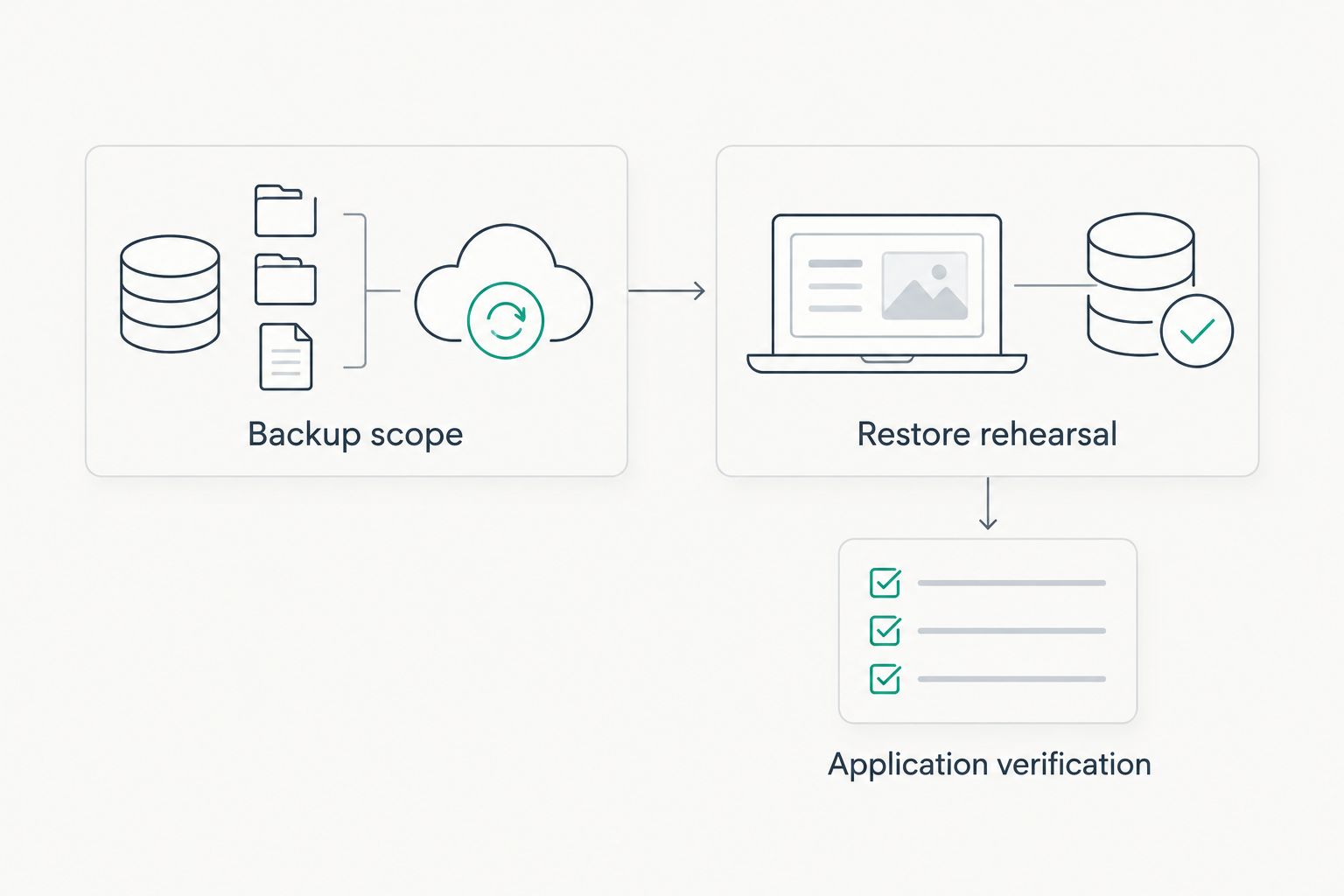
For your 2026 decision, ask who starts a restoration and who confirms completion. The provider with the clearer recovery arrangement wins only if that arrangement satisfies your business requirements.
Pricing models: compare the commitment, not just the server
Compare billing cadence and contractual scope without assuming both offers use identical terms. Ask whether the proposal is recurring or usage-based, what period it covers and which services are billed separately.
A fixed recurring commitment supports predictable budgeting when its scope covers your requirements. Usage-based elements introduce flexibility but require monitoring. These are model tradeoffs to assess in each proposal, not assumptions about either provider's billing.
Check renewal treatment, operating-system licensing, control-panel licensing, administration, backups and migration assistance. Establish whether changes to resources alter the billing commitment or require a separate agreement.
The better commercial offer is the one that covers your required operating model with clear terms. A narrower server-only proposal and a broader administration proposal are not equivalent purchases.
For a 2026 procurement review, keep commercial terms beside the technical specification. Separating them encourages a decision that looks attractive commercially but leaves essential work unassigned.
Final verdict: choose the documented fit
Choose VCCLHosting if you are an India-focused developer
Best for: An Indian business or developer seeking Windows/Linux VPS, dedicated cloud servers or Forex VPS, with a specific interest in deployment from the provider's own Kolhapur datacenter.
The stated service range makes this a direct shortlist for those requirements. Before committing, settle the resource allocation, administrative responsibilities and recovery arrangements in writing; the service range alone does not settle those details.
Choose ServerBasket if its proposal wins your acceptance checks
Best for: A technical buyer with defined requirements whose ServerBasket proposal provides the better documented match for operating-system compatibility, deployment location, resource allocation or operational scope.
Choose ServerBasket when those differences matter to your application and survive verification. Do not award it a general performance, support or commercial win without evidence tied to the proposed service.
One-glance scorecard
| Dimension | Winner |
|---|---|
| Confirmed fit for an owned Kolhapur datacenter | VCCLHosting |
| Operating-system compatibility | Provider confirming your required version and licence terms |
| Resource allocation | Provider documenting the allocation your workload requires |
| Forex workload | Provider meeting platform and broker-connectivity requirements |
| Administration | Tie until task ownership is agreed |
| Recovery | Tie until restoration scope is established |
| Commercial fit | Provider whose billing and service scope match your requirements |
FAQ
Is VCCLHosting better than ServerBasket for Indian businesses?
VCCLHosting is a direct shortlist for Indian businesses seeking its stated Windows/Linux VPS, dedicated cloud or Forex VPS services from its own Kolhapur datacenter. Choose ServerBasket instead when its written proposal better satisfies your application and operating requirements.
Which provider is better for Windows VPS hosting?
Choose the provider that confirms your required Windows version, licensing responsibilities and administration scope. Windows VPS is part of the client's stated offering, but compatibility still needs checking against your application.
Which provider is faster for users in India?
Choose on representative application tests from your users' networks, not a general speed claim. Server location, routing and application behaviour all belong in that assessment.
Which provider should I choose for Forex VPS?
Choose the provider whose environment supports your trading platform and whose connection to your broker meets your requirements. A Forex VPS label does not establish execution speed or trading outcomes.
How should I compare hosting costs in 2026?
Compare billing cadence, renewal terms and the full service scope in each written proposal. Include licensing, administration, backups and migration responsibilities so you assess equivalent purchases.
Does managed hosting mean the provider handles my application?
Treat application administration as included only when the agreed scope says so. Specify responsibility for deployment, updates, databases, monitoring and incident escalation before choosing.
What should I check before migrating to either provider?
Check compatibility, resource allocation, recovery and task ownership before migrating. Rehearse restoration and application verification, then define how you will return to the previous environment if the migration fails.
One last thing
Ask each provider to respond to the same acceptance checklist before you migrate. Include a representative application request, administrative access, a restart check and a restoration rehearsal. This turns your 2026 comparison into a decision you can verify rather than a collection of hosting promises.
Keep the previous environment intact until the replacement passes your checks. A documented rollback route is more useful at migration time than another feature in the comparison table.