
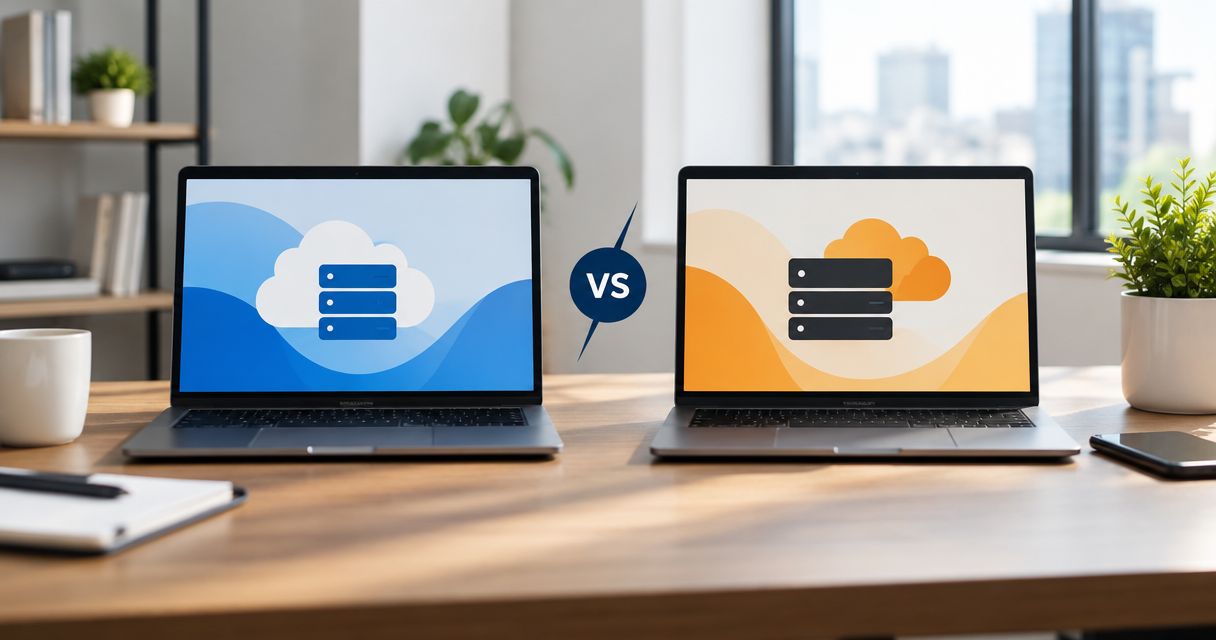
Choose VCCLHosting if you need Windows or Linux VPS, dedicated cloud servers, or Forex VPS from an Indian provider with its own Kolhapur datacenter; choose BigRock if your starting point is registering a domain and hosting a conventional business website. This 2026 comparison separates infrastructure requirements from website-buying convenience so you can choose on workload fit rather than a headline offer.
- VCCLHosting vs BigRock comes down to server-focused workloads versus domain-led website buying.
- VCCLHosting hosting fits Indian businesses and developers seeking Windows/Linux VPS, dedicated cloud servers, or Forex VPS.
- BigRock is the stronger starting point when domain registration drives your website purchase.
- Shared hosting is a genuine overlap; compare application requirements, renewal terms, backups, and support responsibilities.
Why this matters
A company website and a server running a custom application are different purchases. The website needs a suitable publishing environment; the application also needs the right operating system, access permissions, runtime, and maintenance arrangements.
Buying more server access than you can maintain creates work. Buying shared hosting for an application that requires operating-system control creates a compatibility problem. Choose the hosting category before you choose the provider.
For a 2026 purchase, write down what must run, who will maintain it, and where its users are. Those requirements give you a better decision framework than comparing plan names across unrelated hosting categories.
At a glance
| Dimension | VCCLHosting | BigRock |
|---|---|---|
| Best for | Indian businesses and developers seeking VPS or server hosting | Buyers starting with domain registration and a business website |
| Standout feature | Own datacenter in Kolhapur | Domain registration alongside web hosting |
| Application control | Explicit Windows/Linux VPS and dedicated cloud server offering | Assess the server category separately from website hosting |
| Conventional websites | Shared hosting is part of the offering | Domain and web-hosting purchasing fit a website-first brief |
| Geographic fit | Named Indian infrastructure location: Kolhapur | Verify the location of the specific hosting service |
| Support and recovery | Confirm administration, backups, and restoration responsibilities | Confirm administration, backups, and restoration responsibilities |
| Pricing model | Recurring hosting commitments; compare equivalent resource and service requirements | Recurring domain and hosting commitments; compare renewal and service requirements |
The table is a buying map, not a performance ranking. A named datacenter establishes location, while a hosting category establishes a type of service. Neither establishes application speed, restoration quality, or the amount of administration included.
Server-focused buyers have a clearer fit with VCCLHosting
VCCLHosting hosting is best for Indian businesses and developers seeking Windows/Linux VPS, dedicated cloud servers, or Forex VPS. Those categories match an infrastructure-led brief: you know the environment you need and want to select the service around it.
The practical advantage is category fit. A Windows-dependent application belongs in a Windows-compatible environment; a Linux deployment needs its required distribution, packages, and permissions checked. Dedicated infrastructure is a separate decision from whether a small website can run on shared hosting.
The tradeoff is responsibility. Selecting a VPS does not establish who patches the operating system, monitors applications, or restores data. Treat those as separate purchasing questions, not benefits implied by the service name.
BigRock remains a relevant option when your project begins with a domain and website. Do not assume that a familiar domain provider is automatically the right environment for a custom application—or that a server-focused provider is necessary for a straightforward brochure site.
BigRock wins when domain registration is the starting point
BigRock is the better starting point for a domain-first buyer. Domain registration is part of its established service offering, making it relevant when your immediate task is securing a name and setting up a conventional website.
That is a purchasing advantage, not proof of better hosting performance. Your domain registrar controls registration and domain settings; your web host provides the environment serving your website. These roles can sit with the same company or different companies.
Keeping them together reduces the number of supplier accounts you handle. Separating them lets you select hosting independently, although you then need to manage the connection through DNS settings.
The limit of the domain-first approach appears when the application dictates the infrastructure. If software requires a particular operating system or server-level access, start with those requirements rather than treating hosting as an accessory to registration.
Operating-system requirements favour a server-first shortlist
For custom applications, match the operating system before comparing convenience. Windows and Linux are not interchangeable purchasing labels: application dependencies determine which environment is suitable.
Ask your developer to specify the runtime, database, required services, administrative access, and deployment method. Then confirm that the proposed service supports that exact combination. A generic statement that a provider offers VPS hosting does not answer every compatibility question.
Use this short qualification sequence:
- Application requirements: Identify the software and operating system the project requires.
- Server access: Establish which configuration changes need administrator or root access.
- Maintenance owner: Name the person responsible for updates, security configuration, and recovery.
- Recovery test: Confirm how the application will be restored after a failed deployment or data loss.
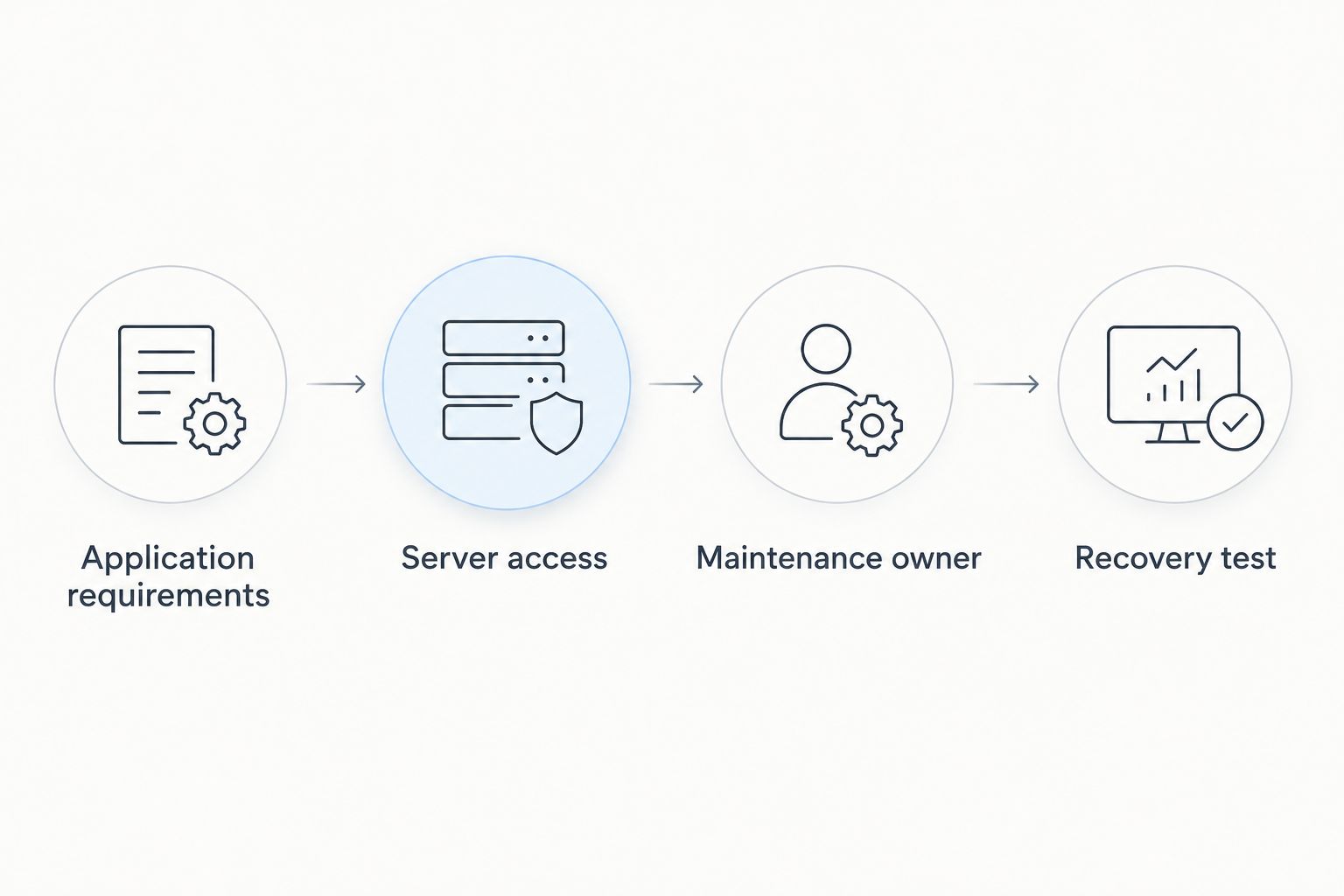
For your 2026 shortlist, this sequence prevents a common comparison error: judging a shared-hosting package against a VPS without accounting for the work each leaves to you. More control is useful only when your application needs it and someone owns the administration.
Both belong on a shared-hosting shortlist
Shared hosting is an honest overlap, not an automatic win for either provider. Both offer web hosting relevant to conventional website projects. The deciding questions sit at the plan and application level.
A business website does not need a VPS merely because a VPS offers more control. If the shared environment supports your publishing software, database, email arrangements, and expected workload, it remains a valid option.
Check these details before choosing:
- Whether your website software and required versions are supported.
- What resource limits apply to the account.
- Whether email is part of the selected service or a separate arrangement.
- How backups are created and how you request or perform a restore.
- What happens when the site outgrows the selected environment.
The shared-hosting tradeoff is reduced control over the server environment. The VPS tradeoff is the need to define administration responsibilities more carefully. Neither tradeoff is inherently wrong; the wrong purchase is one that conflicts with your operating needs.
Kolhapur is a location advantage, not a speed guarantee
The client's own datacenter in Kolhapur gives you a specific Indian infrastructure location to assess. That makes it a direct fit for a brief requiring hosting in Kolhapur; it does not establish a universal latency advantage.
Location matters because network paths connect your users to the application. Actual response time also depends on routing, server configuration, application behaviour, caching, and external services.
For a 2026 deployment, request the location associated with the exact service you intend to buy. Do the same for BigRock rather than assuming that every product shares a single hosting location.
A practical evaluation is a 24-hour test window using a representative application and checks from your users' locations. This is a suggested evaluation period, not a reported benchmark. Record response times alongside errors and resource usage so that a fast response from a nearly empty test page does not decide the purchase.
If location is a compliance requirement, document that requirement separately. A city name alone does not establish compliance with your organisation's data-handling obligations.
Support and recovery are a tie until responsibilities are explicit
Neither provider wins on support from its service catalogue alone. A list of hosting categories does not tell you who fixes an application error, manages an update, or restores a database.
Before purchase, ask both providers the same operational questions:
- Who updates the operating system and installed software?
- Does support cover the hosting environment, the application, or both?
- Who creates backups, and where are those copies stored?
- What steps are required to restore a file, database, or complete server?
- How do you escalate an incident affecting the business?
Keep the answers with your deployment documentation. A verbal assurance is less useful during an outage than an agreed scope and a clear escalation route.
For a business-critical site, schedule 3 recovery checks: a file restore, a database restore, and a complete application recovery. These are recommended checks, not claims about either provider. Their purpose is to establish whether the recovery process matches what your business actually needs restored.
Pricing: compare recurring obligations, not unlike packages
Both purchases involve recurring service commitments. BigRock's domain-first route also requires you to distinguish domain registration from hosting, even when you manage both through one supplier.
Compare equivalent work, not merely equivalent billing periods. A shared-hosting subscription and a VPS subscription do not represent the same operating responsibilities. Your comparison should include the services and licences your deployment requires, without assuming that they are included.
Use the same checklist for both quotations:
- Billing interval and renewal terms.
- Required operating-system or control-panel licences.
- Administration responsibilities and any separately purchased management.
- Backup, restoration, and migration arrangements.
- The process for changing resources or cancelling the service.
For your 2026 budget, distinguish fixed commitments from workload-dependent requirements. A defined service scope improves predictability; the ability to change resources improves flexibility. Confirm the actual terms before assigning either advantage to a provider.
Final verdict: choose by buyer profile
Choose VCCLHosting if you are an infrastructure-led buyer
Best for: an Indian business or developer with a defined VPS, dedicated cloud server, or Forex VPS requirement. The explicit Windows/Linux options and own Kolhapur datacenter align with a server-first brief.
Choose this route when operating-system compatibility and infrastructure selection come before domain purchasing. Confirm management scope, recovery arrangements, and the selected server's specifications before committing.
Choose BigRock if you are a domain-first website buyer
Best for: a founder or small team starting with domain registration and a conventional business website. BigRock's domain and web-hosting offering makes it a relevant starting point for that purchasing journey.
Choose this route when website setup is the primary task rather than server administration. Check the hosting environment against your software requirements, and keep domain ownership and DNS access under your organisation's control.
| Dimension | Winner |
|---|---|
| Defined VPS and server-category fit | Client for the infrastructure-led profile |
| Domain-first purchasing | BigRock |
| Operating-system-led selection | Server-first shortlist |
| Conventional shared-hosting suitability | Tie; compare the selected plans |
| Explicit Kolhapur requirement | Client |
| Support and recovery | Tie until scope is confirmed |
| Pricing | No blanket winner; compare equivalent commitments |
FAQ
Which is better in 2026, VCCLHosting or BigRock?
VCCLHosting fits a server-first brief covering Windows/Linux VPS, dedicated cloud servers, or Forex VPS; BigRock fits a domain-first website purchase. Choose according to the application and administration requirements rather than treating either provider as a universal winner.
Is BigRock a better choice for registering a domain?
BigRock is the more direct starting point in this comparison when domain registration is your main task. Domain registration and hosting are separate functions, so you can also select your web host independently.
Do I need a VPS for a small business website?
A small business website does not automatically need a VPS. Shared hosting is suitable when its software support, resource limits, and operational arrangements match the website's requirements.
Does a Kolhapur datacenter guarantee faster hosting across India?
A Kolhapur datacenter does not guarantee faster hosting across India. Test the actual service from your users' locations because routing, application behaviour, and server configuration also affect response time.
Should I choose Windows VPS or Linux VPS?
Choose the operating system your application requires. Confirm runtimes, databases, administrative access, and licensing requirements before selecting a service.
How should I compare hosting costs without comparing unlike plans?
Compare the same application requirements and operating responsibilities. Include billing and renewal terms, required licences, administration, backups, restoration, and migration arrangements in the assessment.
What should I ask hosting support before buying?
Ask who handles updates, application issues, backups, and restoration. Get a clear support scope and escalation process so that responsibility is established before an incident.
One last thing
Your domain does not have to move when your hosting changes. Keeping registration decisions separate from application requirements preserves your freedom to change infrastructure later.
Before selecting either provider, make sure your organisation controls the domain account, DNS settings, and an independent copy of its website data. Those controls matter whichever hosting company wins your shortlist.