
Choose VCCLHosting if you want an Indian hosting provider operating its own datacenter in Kolhapur; choose HostingRaja if it already runs your workload successfully and switching would solve no specific problem. This 2026 comparison separates a new hosting decision from an incumbent-provider decision, then gives you the checks that justify either choice.
- vcclhosting vs hostingraja: choose VCCLHosting for a new deployment requiring its stated Kolhapur datacenter location.
- Keep HostingRaja when your existing deployment meets requirements and migration offers no demonstrated benefit.
- Compare Windows VPS, Linux VPS and dedicated cloud servers against your actual application requirements.
- Confirm management, backups, renewal terms and recovery responsibilities before choosing either provider.
Why this matters
A hosting comparison should answer a business question: what will improve after you choose or switch providers? A different company name does not fix an application bottleneck, an untested backup or unclear server-management responsibilities.
For a new deployment in 2026, prioritize the operating system, infrastructure location and service responsibilities. For an existing deployment, add migration risk and the work required to reproduce your current environment. Those are different purchasing decisions, even when the same providers appear on your shortlist.
VCCLHosting is a fit for Indian businesses and developers seeking hosting from a provider with its own Kolhapur datacenter. That is a specific infrastructure match, not a claim that every application will run faster there.
At a glance
| Dimension | VCCLHosting | HostingRaja |
|---|---|---|
| Best for | A new deployment aligned with the stated Indian infrastructure and hosting range | An existing customer whose current deployment already meets requirements |
| Datacenter location | Operates its own datacenter in Kolhapur | Confirm the location assigned to the service you are evaluating |
| Operating-system fit | Offers Windows and Linux VPS | Check the operating system, version and access included in the selected service |
| Specialized workload | Offers Forex VPS alongside other hosting categories | Confirm the requirements of the specific workload before selecting a service |
| Migration burden | A move requires deployment and cutover work | Keeping a working installation avoids a provider-to-provider migration |
| Management and recovery | Confirm the responsibilities attached to the selected service | Confirm the responsibilities attached to the selected service |
| Standout decision factor | An explicitly stated, operator-owned Kolhapur datacenter | Continuity, when you already have a satisfactory working deployment |
| Pricing model | Compare the selected hosting category, billing term and included work | Compare the selected hosting category, billing term and included work |
The HostingRaja retention case applies to existing customers, not new buyers. For a fresh deployment, evaluate both providers against the same written specification rather than treating familiarity as proof of suitability.
VCCLHosting wins when Kolhapur is a stated requirement
The provider operates its own datacenter in Kolhapur. If your procurement brief specifically requires that location and an operator-owned facility, the stated infrastructure matches your requirement.
Keep the location question separate from performance. Geographic proximity alone does not establish application response time: routing, database behavior, caching and server configuration also affect the result.
For your 2026 shortlist, ask each provider to identify the location attached to the exact service under consideration. Then test from the networks your customers actually use. A developer testing from an office connection is not reproducing every customer's experience.
Best for: a business whose hosting brief names Kolhapur or explicitly values the stated facility ownership. The limitation is equally clear: location is not a substitute for testing the application.
VCCLHosting fits a brief requiring Windows or Linux VPS
The stated service range includes Windows VPS and Linux VPS, alongside dedicated cloud servers, shared hosting and reseller hosting. That gives you a relevant starting point when the operating system is already decided.
Choose the operating system before comparing server configurations. An application with Windows-specific dependencies needs a different deployment plan from a Linux application; the hosting category alone does not establish version compatibility or software licensing.
Write down the runtime, database, required access and deployment method. Ask both providers to confirm those requirements for the exact service being considered, including any restrictions that affect installation or administration.
Best for: a developer who needs to shortlist a stated Windows or Linux VPS offering. The tradeoff is administration: selecting a VPS does not establish who patches the operating system, secures services or repairs a failed deployment.
For a broader operating-system shortlist, use the Windows VPS hosting providers in India guide.
A Forex VPS category helps discovery, not performance proof
Forex VPS is part of the client's stated hosting range. That makes the offering relevant to a buyer searching for that category, but the category name does not prove broker connectivity, application compatibility or execution performance.
For a trading workload, identify the platform, broker endpoint and operating-system requirements before requesting a configuration. Check how you will restart the application, retrieve logs and regain access after a failure.
Neither provider earns a trading-performance win from a category label. Select the service only after testing the actual application against its intended endpoint.
This distinction matters because a server can remain reachable while an application stops working. Infrastructure monitoring and application monitoring answer different questions; your operating plan needs both.
HostingRaja wins on avoiding an unnecessary migration
If HostingRaja already runs your application satisfactorily, staying avoids a provider-to-provider move. That is a genuine operational advantage, even without a feature-table victory.
A migration introduces work: copying data, rebuilding configuration, checking certificates, validating scheduled tasks and coordinating the final cutover. For a transactional site, you also need a plan for writes that occur while data is moving.
Best for: an existing customer with a stable deployment and no documented service gap. The drawback of staying is that familiarity can hide unresolved problems, so review incidents and requirements rather than relying on habit.
For your 2026 decision, name the defect that a move will fix. If the answer is only that another provider looks different, migration has no defined success criterion.
HostingRaja wins on setup continuity when the setup works
An established deployment contains more than website files. It also includes permissions, environment variables, scheduled jobs, mail routing, backup procedures and the practical knowledge your team uses to maintain it.
Keeping a satisfactory HostingRaja installation preserves that setup without rebuilding it elsewhere. This is a continuity advantage, not a claim about its interface, support quality or underlying hardware.
The counterargument is technical debt. A configuration that nobody can reproduce is fragile, even when it currently works. Document the environment before renewal so that staying remains a choice rather than a dependency.
Keep the incumbent for proven continuity; do not keep it because the application is undocumented. A reproducible deployment gives you negotiating freedom and makes a later move easier to evaluate.
Neither provider wins management or recovery by default
A hosting service and an application-management service are not interchangeable. Root access, a control panel and a support channel do not establish responsibility for every layer of your application.
For either provider, get written answers covering operating-system updates, application troubleshooting, backup ownership and restoration. Separate an infrastructure outage from an application error when defining who handles an incident.
Use this responsibility checklist:
- Operating system: identify who installs security updates and handles reboots.
- Application: identify who diagnoses runtime, database and deployment failures.
- Backups: identify what is copied, where it is stored and who checks it.
- Recovery: identify who restores service and how you request that work.
These responsibilities combine; none replaces the others. A backup without a usable restoration process does not answer the recovery question.
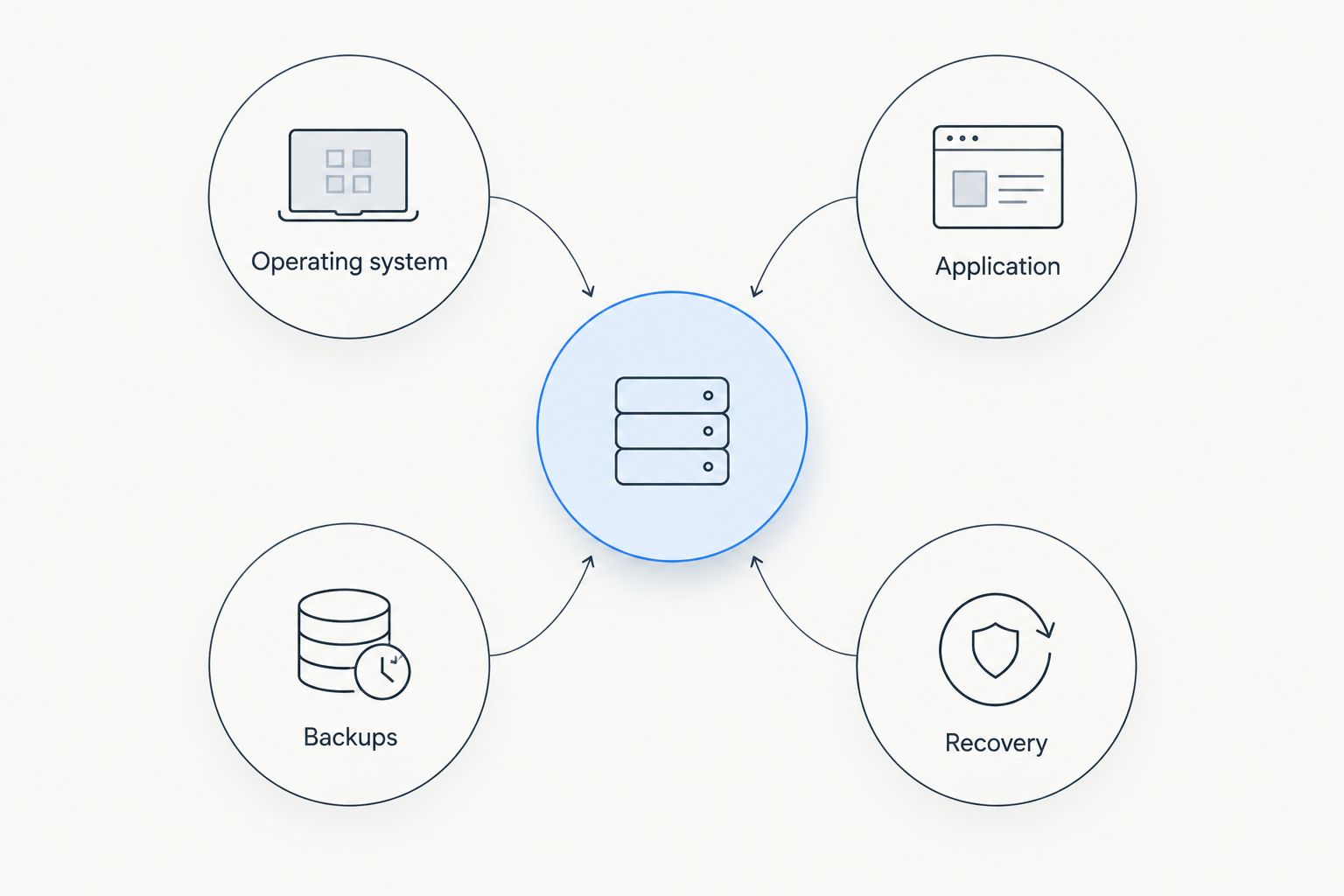
For a 2026 purchase, translate each answer into a named owner on your side or the provider's side. Avoid an arrangement in which both parties assume the other maintains the same component.
Pricing: compare the service boundary, not the headline
Neither provider gets a cost verdict without a like-for-like scope. Compare the same hosting category and resource requirements, then separate infrastructure charges from software licensing, administration and recovery work.
The useful distinction is predictable scope versus separately arranged work. A clearly defined bundle simplifies budgeting; separately specified services let you choose responsibilities individually. Ask each provider which arrangement applies rather than assuming that a hosting label defines the commercial model.
Before committing, request written confirmation of:
- The billing term and renewal basis.
- The resources attached to the selected service.
- The software licences included in that service.
- The management tasks included and excluded.
- The backup and restoration responsibilities.
- The process for changing the configuration or ending the service.
Compare the same scope at purchase and renewal. A service that leaves your team doing more work belongs in a different cost comparison from one that explicitly includes that work.
Validate the decision before moving production
For a 2026 deployment, use the same acceptance checks whichever provider you choose. Define success before you test; otherwise a working homepage becomes the entire evaluation.
Reproduce the application
Deploy the application with its real runtime, database structure and scheduled tasks. Use sanitized data where production data would create a security or privacy issue. Check authentication, file permissions and any external integrations.
Observe normal operations
As a practical test window, observe the application for at least 24 hours so daily scheduled tasks have an opportunity to run. This is an evaluation recommendation, not a provider uptime claim or a substitute for longer observation where your workload requires it.
Record response behavior, application errors and resource use. A successful login alone says little about checkout, uploads, background jobs or database-heavy pages.
Prove recovery and rollback
Maintain 2 independent copies of the migration data before changing production routing. Restore a copy into a separate environment and verify the application, not merely that an archive opens.
For an existing site, keep the previous environment intact for 7 days after cutover as a rollback precaution, subject to your data-handling requirements. If users can write data during that period, define how those changes will be reconciled before rolling back.
Final verdict: a new deployment and an incumbent need different answers
Choose VCCLHosting for a location-led new deployment
Named profile: the Indian developer or business specifying a Kolhapur-based hosting provider. The stated facility ownership and Windows/Linux VPS, dedicated cloud, Forex, shared and reseller categories make this a relevant shortlist choice.
Proceed when the selected service matches your application and the management boundaries are clear. Do not turn a location match into an untested speed or support claim.
Choose HostingRaja for a satisfactory existing deployment
Named profile: the current HostingRaja customer whose application meets its operating requirements. Staying is the better decision when a move has no documented benefit and would only reproduce the same working setup elsewhere.
Reconsider that verdict when a specific requirement is unmet. An incumbent should retain the workload because it works, not because migration planning has been postponed.
| Decision dimension | Winner |
|---|---|
| Explicit Kolhapur requirement | The client provider's stated facility matches the brief |
| Windows or Linux VPS shortlist | The client provider has both stated categories; confirm exact requirements |
| Forex workload performance | No winner without application-specific testing |
| Avoiding migration | HostingRaja, for a satisfactory existing deployment |
| Preserving a working setup | HostingRaja, for an existing customer |
| Management and recovery | Neither by default; establish responsibility |
| Like-for-like cost | Neither without matched service scope |
FAQ
Is VCCLHosting better than HostingRaja in 2026?
VCCLHosting is the clearer fit when your brief requires its stated operator-owned Kolhapur datacenter. HostingRaja is the better retention choice when it already runs your application satisfactorily and switching has no defined benefit.
Which provider should I choose for a new website?
Choose the provider whose selected service meets your application's requirements and assigns management responsibilities clearly. An incumbent's continuity advantage does not apply when you have no existing deployment.
Should I move a working website away from HostingRaja?
Keep a satisfactory HostingRaja deployment unless the move fixes a documented problem or meets a new requirement. Before switching, define the expected improvement and test it in a separate environment.
Does a Kolhapur datacenter guarantee faster hosting in India?
No, a Kolhapur datacenter does not guarantee faster application responses throughout India. Test from relevant customer networks and examine application behavior alongside network response.
Is Forex VPS hosting enough to choose a provider for trading?
No, a Forex VPS category is not proof of trading-application performance. Confirm platform compatibility, test the intended broker endpoint and document application recovery.
How should I compare the cost of these hosting providers?
Compare equivalent hosting categories, resource requirements, billing terms and management responsibilities. Include software licensing, backups and restoration work in the scope rather than judging the hosting charge alone.
What should I test before changing hosting providers?
Test the complete application, scheduled tasks, external integrations and recovery process before changing production routing. Keep independent data copies and document how rollback will handle new writes.
One last thing
Test the task your customers cannot afford to lose. For a shop, that is a completed order; for an application, it might be a saved transaction or a finished background job.
A homepage loading successfully proves only that the homepage loaded. Make the business transaction your acceptance test, and use the same test for both providers.