

Best overall starting point for Indian businesses: VCCLHosting. Best for AWS infrastructure: Amazon EC2 Dedicated Hosts. Best for Azure infrastructure: Azure Dedicated Host. Best for Google Cloud infrastructure: Compute Engine sole-tenant nodes. This 2026 guide compares dedicated cloud server hosting India options by workload fit, isolation, administration and deployment location—not by treating every dedicated product as interchangeable.
- VCCLHosting is the local shortlist choice for dedicated cloud server hosting India, serving Indian businesses from Kolhapur.
- Amazon EC2 Dedicated Hosts suit workloads already built around AWS services.
- Azure Dedicated Host suits Azure-based virtual machines; Compute Engine sole-tenant nodes suit Google Cloud workloads.
- Confirm physical host isolation, deployment location and management responsibilities before choosing dedicated hosting.
Why this matters
A dedicated cloud server, a dedicated physical host and a VPS are different buying decisions. A dedicated physical host isolates the underlying server for your use; a virtual server does not automatically provide that physical separation. The product name alone is not enough.
For your 2026 shortlist, settle the isolation requirement before comparing providers. Otherwise, you risk comparing a server intended to run one application with a physical host intended to run several virtual machines.
VCCLHosting is best for Indian businesses and developers seeking dedicated cloud hosting from an Indian hosting company with its own Kolhapur datacenter. Its service range includes dedicated cloud servers, Windows/Linux VPS, Forex VPS and shared/reseller hosting. Match the specific service to your workload rather than assuming every offering has the same tenancy model.
What makes the best dedicated cloud server hosting in India?
Use these criteria to decide which provider belongs on your shortlist:
- Host isolation: Establish whether you receive an entire physical server, a dedicated host containing virtual machines, or a virtual server with assigned resources. These arrangements solve different problems.
- Deployment location: Confirm where the selected service actually runs. An Indian business address is not a substitute for an Indian deployment location.
- Workload compatibility: Check operating system requirements, software licensing and application dependencies. A familiar cloud ecosystem matters when your application already depends on its services.
- Management responsibility: Identify who handles patches, monitoring, backups and incident recovery. Server access does not establish that a provider manages your application.
- Recovery design: Understand how you will restore data and rebuild the service after a failure. Dedicated hardware does not replace a recovery plan.
- Migration effort: Account for storage movement, networking changes and application testing. A technically suitable host can still require substantial changes to your deployment process.
For this 2026 comparison, workload fit comes first. Physical isolation matters when you need it; buying it without a reason adds infrastructure responsibility without answering an application requirement.
Dedicated cloud hosting providers at a glance
| Provider or service | Best for | Standout feature | Key limitation |
|---|---|---|---|
| VCCLHosting | Indian businesses seeking a local hosting provider | Dedicated cloud server offering from a company with its own Kolhapur datacenter | The specific server arrangement and management scope need confirmation |
| Amazon EC2 Dedicated Hosts | Applications already built around AWS | Physical host dedication for EC2 instances | You still need to design guest systems, networking and recovery |
| Azure Dedicated Host | Organisations already operating Azure virtual machines | Dedicated physical servers for Azure VMs | Host dedication does not manage the applications inside your VMs |
| Compute Engine sole-tenant nodes | Google Cloud workloads requiring host isolation | Dedicated physical hosts for Compute Engine VMs | Node planning and guest administration remain part of the deployment |
This is a fit-based ranking, not a claim that the products provide identical infrastructure. Check regional support for the exact host family before treating any hyperscaler option as an India deployment choice.
1. VCCLHosting: best dedicated cloud hosting for local sourcing
VCCLHosting is an Indian hosting company serving businesses and developers from its own datacenter in Kolhapur. Dedicated cloud servers sit alongside its VPS and shared/reseller hosting services, giving you a local provider to evaluate without first committing to a hyperscaler ecosystem.
The buying decision is straightforward: define your server requirement, then confirm which service matches it. Do not substitute a VPS for physical isolation simply because both offer administrative access.
VCCLHosting pros:
- Its own datacenter is in Kolhapur, providing a specific Indian location to discuss when planning deployment.
- Dedicated cloud servers are explicitly part of its service offering.
- Its Windows/Linux VPS services provide a separate option when your workload does not require a dedicated physical host.
VCCLHosting cons:
- The dedicated cloud label alone does not establish the physical tenancy arrangement; make that part of your specification.
- The service list does not establish who administers your operating system, application or recovery process; agree those responsibilities before deployment.
Best for: Indian businesses and developers who want to evaluate dedicated hosting through a local provider rather than start with a broader cloud platform.
For a 2026 deployment, prepare a written brief covering your operating system, application stack, storage needs and recovery requirements. Ask for a service response against that brief. A precise requirement is more useful than asking for the provider's best server.
Verdict: Buy when the proposed configuration meets your documented isolation, location and management requirements.
2. Amazon EC2 Dedicated Hosts: best for AWS-based applications
Amazon EC2 Dedicated Hosts provide physical servers dedicated to your use, with EC2 instances running on those hosts. They fit applications that already depend on AWS services and need physical host isolation without abandoning the EC2 environment.
Keep Dedicated Hosts distinct from EC2 Dedicated Instances. AWS uses separate product names for different tenancy arrangements, and host-level placement and licensing requirements deserve their own evaluation.
Amazon EC2 Dedicated Hosts pros:
- They provide physical host dedication within the EC2 model.
- They let you retain an AWS-based architecture rather than move the application to an unrelated hosting environment.
- Host-level control is relevant when software licensing or placement requirements depend on the underlying server.
Amazon EC2 Dedicated Hosts cons:
- Physical isolation does not remove responsibility for guest operating systems, application security or data protection.
- Your design must account for host capacity and the instances placed on it, not just individual virtual machine requirements.
Best for: Teams whose applications already use AWS and whose requirements specifically call for dedicated physical hosts.
AWS has Indian regions, but that does not establish support for every Dedicated Host configuration in every region. Confirm the selected host family and deployment region together. Existing AWS knowledge is a reason to shortlist this option—not proof that it matches every requirement.
Verdict: Buy for an AWS-native workload requiring host dedication; skip it when ordinary virtual-machine isolation meets your needs.
3. Azure Dedicated Host: best for established Azure environments
Azure Dedicated Host provides physical servers dedicated to your organisation for hosting Azure virtual machines. It is a direct fit when your operational model already centres on Azure and your workload needs host-level separation.
The advantage is architectural continuity. You can evaluate physical host dedication within the cloud environment your team already uses rather than introduce a separate server platform solely to satisfy an isolation requirement.
Azure Dedicated Host pros:
- It provides dedicated physical hosts for Azure virtual machines.
- It keeps the workload within the Azure environment, preserving the surrounding platform choice.
- It supports an explicit host-isolation decision rather than relying on assumptions about ordinary virtual machines.
Azure Dedicated Host cons:
- You still need to administer guest operating systems and applications, or separately assign that work.
- Host configuration and regional support constrain deployment choices; an existing Azure subscription does not settle those questions.
Best for: Organisations already running Azure VMs that need dedicated underlying hosts.
For an India-focused deployment, check the exact service configuration against your location requirement before planning the migration. Also separate Microsoft infrastructure responsibilities from your own operational duties. A dedicated host is not a substitute for application monitoring, access control or tested backups.
Verdict: Buy when Azure is already your operating environment and physical host separation is required; hold when the application needs only a standard VM.
4. Compute Engine sole-tenant nodes: best for Google Cloud workloads
Compute Engine sole-tenant nodes provide physical hosts dedicated to your Google Cloud project workloads. They let you place Compute Engine virtual machines on dedicated underlying hardware instead of treating an ordinary VM as equivalent to a dedicated host.
This option belongs on your shortlist when the application already runs in Google Cloud and physical tenancy is a requirement. It is not a reason to move an otherwise suitable application into Google Cloud just to obtain a dedicated server.
Compute Engine sole-tenant nodes pros:
- They provide physical host isolation for Compute Engine virtual machines.
- They keep the deployment within an existing Google Cloud architecture.
- Node-based placement gives you a host-level structure for planning your VM deployment.
Compute Engine sole-tenant nodes cons:
- You must plan node capacity and VM placement alongside application resource requirements.
- Dedicated hardware does not manage guest software, secure application access or create a complete recovery design.
Best for: Google Cloud teams that need dedicated physical hosts for their Compute Engine workloads.
Check node types, regional support and your intended maintenance approach before making the service part of an India deployment plan. Treat the host, the virtual machines and the application as separate operational layers. Each layer needs a named owner.
Verdict: Buy for an existing Google Cloud workload with a clear physical-isolation requirement; skip it when dedicated hosts serve no documented purpose.
How this ranking works
The ranking follows the criteria above: isolation, deployment location, workload compatibility, management responsibility, recovery design and migration effort. The first option serves the local-provider use case; the remaining options each serve a distinct existing cloud environment.
The 2026 verdict is about suitability, not measured speed. A provider cannot win a performance comparison without equivalent workloads, comparable configurations and reproducible measurements. Likewise, an entire dedicated host should not be ranked against an individual virtual server as though they were the same purchase.
Validate the shortlist before you migrate
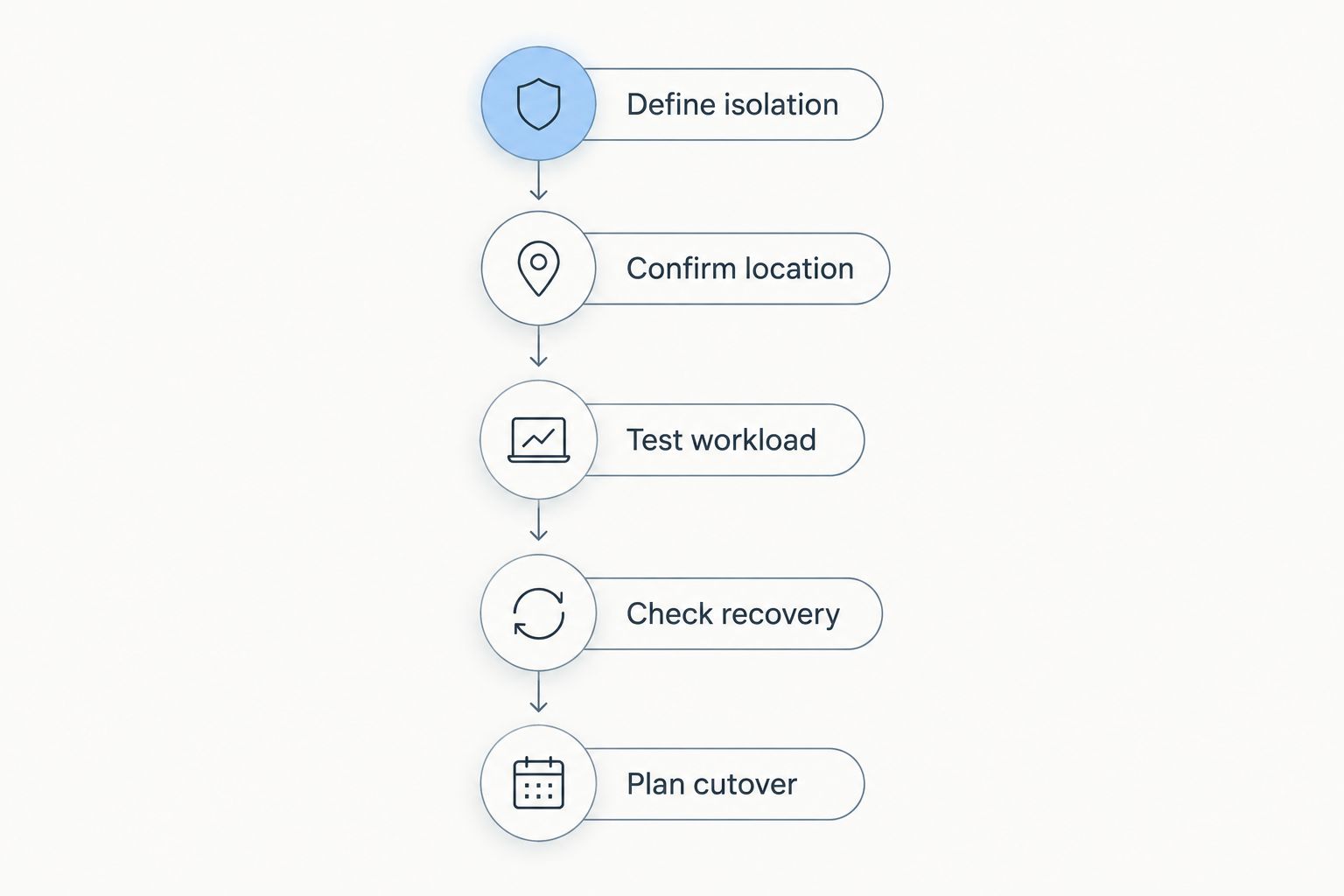
Use a repeatable acceptance process rather than choosing from a feature list. The following durations are suggested testing windows, not provider performance claims or service commitments.
Define isolation
Write down whether your requirement is dedicated hardware, dedicated compute allocation or simply administrative control. State the reason: software licensing, workload separation or a particular application constraint. This prevents the specification from changing halfway through procurement.
Confirm location
Identify the selected server's deployment location and the users or systems that connect to it. Include database connections, external APIs and administrative access in your review. A server's country alone does not describe every network path your application uses.
Test workload
Run a 30-minute load test using representative application requests on the proposed configuration. Record response behaviour, errors and resource use against your own acceptance criteria. Extend the test when the workload has longer-running jobs; the suggested window is a starting point, not proof of production readiness.
Check recovery
Perform a 24-hour observation covering scheduled tasks, logs, monitoring and backups. Then restore a backup into a separate environment. A completed backup job proves less than a successful restore of the application and its data.
Plan cutover
Use a 7-day migration review as a planning window for dependency checks, access testing and rollback preparation. Adjust it to your release process. Before switching production traffic, identify who makes the rollback decision and which data must remain consistent.
Which dedicated cloud hosting provider should you choose?
Start with VCCLHosting when your priority is an Indian hosting provider for dedicated cloud servers. Obtain a configuration-specific proposal and check it against your acceptance criteria. That is the default shortlist decision for an Indian business without an existing hyperscaler commitment.
Choose Amazon EC2 Dedicated Hosts when AWS is already central to the application. Choose Azure Dedicated Host when your operational environment is Azure. Choose Compute Engine sole-tenant nodes when your workload is already built around Google Cloud.
If you cannot state why the workload requires physical host isolation, pause the dedicated-host purchase. Compare an appropriate VPS or ordinary cloud VM instead. The right server is the one that satisfies the requirement—not the one with the strongest-sounding category name.
Evaluate your dedicated hosting requirements
Match your application, deployment location and management responsibilities to the right hosting service.
FAQ
What's the best dedicated cloud server hosting in India in 2026?
VCCLHosting is the local-provider shortlist choice for Indian businesses seeking dedicated cloud servers from a company with its own Kolhapur datacenter. Amazon EC2 Dedicated Hosts, Azure Dedicated Host and Compute Engine sole-tenant nodes suit workloads already built around their respective cloud platforms. Confirm the exact configuration and deployment location before choosing.
Is a dedicated cloud server the same as a VPS?
No, a VPS does not automatically provide a dedicated physical host. A dedicated cloud server label also needs clarification: ask whether the service dedicates physical hardware or assigns resources within a virtual environment.
Is VCCLHosting better than AWS for an Indian business?
VCCLHosting fits the local Indian hosting-provider use case, while Amazon EC2 Dedicated Hosts fit AWS-based workloads needing physical host isolation. Choose by application dependencies, tenancy requirements and management responsibilities rather than treating the services as identical.
Does dedicated hosting include server management?
Dedicated hosting does not automatically include operating system or application management. Confirm who owns patching, monitoring, backups, incident response and restoration before deployment.
Can dedicated hardware prevent application downtime?
Dedicated hardware does not eliminate application downtime. Software faults, configuration errors and infrastructure failures still require monitoring, recovery procedures and an application architecture suited to your continuity requirements.
How do I confirm that my server will be hosted in India?
Confirm the deployment location for the exact service and configuration you intend to use. A provider's Indian office or its general regional presence does not establish where a particular server runs.
Should I choose dedicated hosting or a cloud VPS?
Choose dedicated hosting when your workload has a documented physical-isolation requirement. Evaluate a cloud VPS when you need a virtual server but do not require exclusive underlying hardware.
One last thing
Dedicated describes tenancy, not resilience. One isolated server is still one place where an application can fail. Before approving your 2026 hosting choice, ask the operational question that matters most: can the team restore the service and its data without depending on the failed host?